
Federal Prison Release Paths
The Bureau of Prisons holds people serving federal sentences and manages some community-custody placements. It does not operate Hardin County Detention Center, a Kentucky prison, or Fort Knox military custody. No BOP prison was identified in Hardin County. A federal defendant with a local tie may be held in another jurisdiction before designation and later serve at a federal institution elsewhere.
A BOP departure can mean release to the community, transfer to another sovereign, or movement into another status. Supervised release is a court-ordered term in the community after prison and is distinct from BOP imprisonment. Immigration authorities, a state, another country, or another custodian may assume control. BOP therefore uses a narrow and accurate idea: no longer in BOP custody.
| Record | What it establishes | What it cannot establish alone |
|---|---|---|
| BOP release date | Departure reported by BOP | No later custody |
| Federal judgment | Sentence and supervision terms | Exact processing time |
| USMS record | Pretrial or transport event | Broad public history |
| ICE or state result | Other sovereign's custody | BOP sentence details |
Search Federal Prison Releases
The BOP Inmate Locator covers federal inmate records generally from 1982 forward and some older records. A register number provides the strongest search. Name searching can add age, race, and sex filters, but those fields should be used only to distinguish records, not to assume a match.
- Search the BOP register number when it is known.
- Otherwise enter the exact name and use only needed matching filters.
- Compare the register number, name, age, and any location shown.
- Read the release date and custody wording exactly as displayed.
- Check the federal docket or another sovereign if the next status matters.
A past release date and no current BOP facility indicates that BOP reports the person as no longer in its custody. A deceased record may also carry a date, so read the full result. BOP warns that First Step Act recalculations can change displayed dates. Save the retrieval date and do not treat a future date as fixed.
“Released” or “Not in BOP Custody” does not rule out state, immigration, foreign, military, parole, or supervised-release authority.
BOP Locator Release Screen
The official BOP locator entry is the correct public search route for a sentenced federal prisoner. The search screen below helps identify the federal tool and its register-number option.
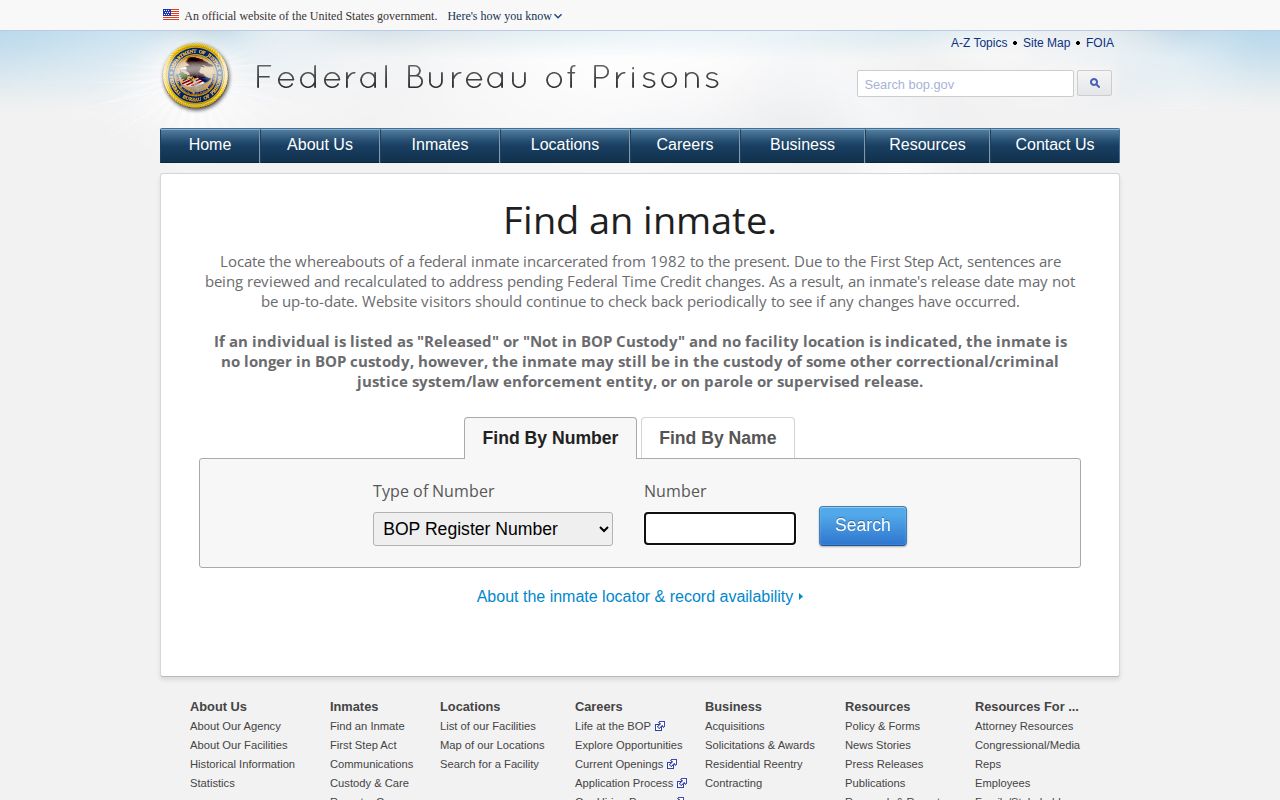
The locator is a national federal source, not a Hardin County roster. A matching result should be reconciled with the federal case and any later custodian when the difference between community release and transfer matters.
Federal Bureau of PrisonsInmate Locator and public information
National federal prison system
Use the official BOP web contact routes
Federal Court Release Authority
The federal docket supplies the legal basis for detention, sentence, or release. A judgment may state imprisonment and supervised release. A detention or release order can govern a pretrial defendant. PACER or the clerk for the responsible U.S. District Court is the route to the filed order. The order date can precede physical processing or a transfer.
The U.S. Marshals Service handles many federal pretrial prisoners from court commitment through acquittal, release, or delivery after conviction. It has no public historical released-person locator equal to BOP's tool. A narrow USMS FOIA request may seek an existing, identified record. Public guidance limits prisoner personal histories, photographs, and arrival or departure details, so those materials should not be promised.
- Register number
- The BOP identifier used to distinguish a federal inmate record.
- Supervised release
- A federal court term served in the community after prison.
- Detainer
- A request or authority that may lead to continued custody elsewhere.
- FOIA
- The federal process for requesting agency records, subject to exemptions.
Hardin County Federal Distinctions
A Hardin County arrest or case is not federal merely because Fort Knox is nearby. The county jail, Kentucky Department of Corrections, BOP, ICE, and military authorities keep separate records. Determine which court issued the process and which agency held the person. A county roster disappearance cannot confirm a BOP release, while a BOP result cannot answer a local bond-out.
Fort Knox is a Department of Defense installation, not a general BOP prison. Military apprehension follows military law-enforcement and corrections channels. A civilian federal prosecution connected to the area may use a contract jail outside Hardin County before BOP designation. Search the person and register number nationally instead of limiting the inquiry to Elizabethtown.
The Hardin County released inmate search describes the county and state routes. Use it when the person was booked at Lawson Boulevard or sentenced under Kentucky law. For a federal record, keep the BOP release date, federal judgment, and any later state or ICE result in separate columns rather than blending them into one event.
Request Federal Release Records
When the locator is not enough, identify the agency record and the person precisely. A BOP request should include the full name, register number, institution if known, and narrow date range. Ask for the existing release or transfer record needed to resolve the event. A federal court request should identify the case number and document, such as a judgment or release order.
Privacy and law-enforcement exemptions can limit details. USMS may not release personal history or movement information. BOP locator data can also change as calculations are updated. Requesting a record does not require an agency to create a new analysis or certify that no other sovereign took custody.
Strong confirmation combines the responsible custodian's affirmative event with the legal authority. If BOP shows departure but a state or ICE record shows intake, describe a transfer. If the court imposed supervised release and no later custody appears, describe release from prison with court supervision. Keep each conclusion tied to its source and date.
Older federal events need the same care. The locator generally reaches back to 1982, but some earlier records have different coverage. A missing result may call for an agency request or court-file search rather than a claim that no federal custody existed. Register numbers can include agency prefixes, so copy the identifier exactly. When a release date conflicts with a later docket entry, preserve both and ask which event each date describes.